

Introduction
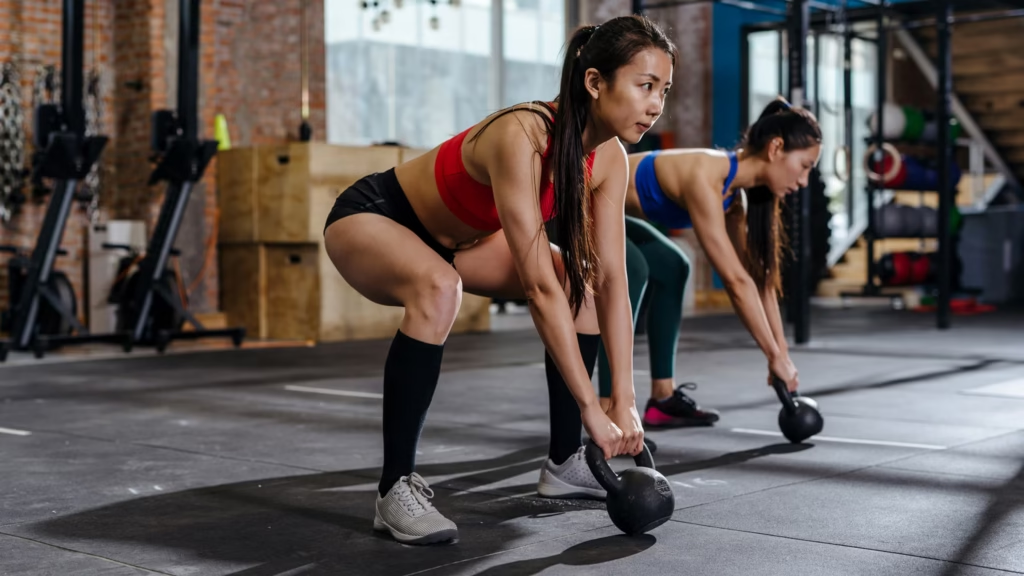
Improving athletic performance goes beyond simply lifting heavier weights. It requires a strategic approach to strength training that builds a resilient, powerful, and efficient body capable of excelling in any sport. Whether you’re a runner looking for more speed, a basketball player aiming for higher jumps, or a weekend warrior seeking better agility, the right foundational strength work is non-negotiable. This guide focuses on compound movements and functional strength exercises that translate directly to the field, court, track, or pool. By developing a robust physical base, athletes can enhance power output, reduce injury risk, and unlock a new level of competitive ability.
Foundations of Athletic Strength Training
Before diving into specific movements, understanding the core principles of performance-focused strength work is vital. Athletic strength is not solely about maximal force; it’s about force applied quickly, efficiently, and repeatedly under various conditions. This involves training movement patterns—like pushing, pulling, squatting, hinging, and carrying—rather than just isolating individual muscles. A well-structured program balances maximal strength, explosive power, and muscular endurance, all while prioritizing proper joint mobility and stability. The goal is to create an athlete who moves with confidence and control.
Essential Strength Exercises for Total Athleticism
The following exercises are selected for their proven impact on multiple athletic qualities. They form a cornerstone regimen that can be adapted for nearly any sport.
Squat Variations
The squat is a fundamental human movement and a primary developer of lower body strength. It targets the quadriceps, glutes, hamstrings, and core, essential for running, jumping, and changing direction.
- Back Squat: This is a primary builder of absolute strength. The athlete rests a barbell across the upper back, descends until the hips are below the knees (or to a safe, depth-controlled position), and drives back up. It builds foundational leg and hip strength.
- Tip: Keep the chest up and the spine neutral throughout the movement. Drive through the entire foot, not just the toes.
- Pro: Excellent for developing raw strength and muscle mass in the lower body.
- Con: Requires good mobility in the ankles, hips, and thoracic spine to perform correctly.
- Front Squat: By holding the weight in front of the body, this variation places more emphasis on the quadriceps and upper back. It demands and builds superior core stability and an upright torso.
- Tip: Keep elbows high to maintain the barbell rack position. This is highly beneficial for athletes in sports requiring an upright posture, like wrestling or judo.
Deadlift Patterns
Deadlifts are unparalleled for building posterior chain strength—the glutes, hamstrings, and back muscles—which are critical for sprinting and power generation.
- Conventional Deadlift: Starting with a barbell on the floor, the athlete hinges at the hips and knees, grips the bar, and stands up by extending the hips. It teaches powerful hip extension.
- Tip: Initiate the movement by pushing the floor away with your feet, not by pulling with the back. Keep the bar close to the body.
- Pro: Develops tremendous overall strength and hip power.
- Con: Form breakdown can lead to lower back strain; technique is paramount.
- Romanian Deadlift (RDL): This variation focuses on the hamstrings and glutes through a controlled hip hinge. With a slight knee bend, the athlete lowers the torso by pushing the hips back, maintaining a flat back, then returns to standing.
- Tip: Feel a deep stretch in the hamstrings. This exercise is superb for improving sprint mechanics and hamstring resilience.
Pressing and Pulling for Upper Body Power
A strong upper body contributes to force transfer, contact stability, and overall athletic posture.
- Overhead Press: Pressing a weight from the shoulders to overhead develops shoulder stability, triceps strength, and core bracing. This is crucial for sports involving throwing or pushing opponents.
- Tip: Brace the core and glutes hard to avoid excessive arching in the lower back.
- Pull-Ups/Chin-Ups: The ultimate bodyweight test of upper body pulling strength. They develop the latissimus dorsi, biceps, and grip, essential for climbing, gymnastics, and maintaining posture in contact sports.
- Tip: Initiate the pull by driving the elbows down and back, not just by pulling with the arms.
Plyometric and Power Movements
To convert pure strength into speed, plyometric exercises are essential. They train the muscles to produce force rapidly.
- Box Jumps: An athlete jumps from the ground onto a sturdy box of moderate height, focusing on a soft, quiet landing with knees aligned over toes. This develops explosive power and teaches landing mechanics.
- Tip: The focus should be on the quality and speed of the jump, not the maximum box height. Step down, do not jump down, between repetitions.
- Medicine Ball Throws: Throwing a weighted ball (e.g., chest passes, overhead slams) trains the entire body to coordinate force production in a dynamic, sport-specific manner.
- Tip: Use the legs and hips to generate force, not just the arms.
Building a Balanced Program
Integrating these exercises requires balance. A sample weekly framework for an athlete in-season might include two strength sessions:
- Session A: Back Squat, Romanian Deadlift, Overhead Press, Pull-Ups, Core Plank.
- Session B: Front Squat, Conventional Deadlift (lighter volume), Box Jumps, Medicine Ball Slams, Rowing.
Always begin each session with a dynamic warm-up and include mobility work post-session. Progressive overload—gradually increasing weight, volume, or intensity—is key for continuous improvement. Listening to the body and allowing for adequate recovery is just as important as the training itself.
Common Mistakes and How to Avoid Them
Several frequent errors can hinder progress or lead to injury. Neglecting proper warm-up routines reduces performance and readiness. Prioritizing weight over perfect technique is a primary cause of injury; the movement pattern must always come first. Imbalanced training, such as focusing only on the “mirror muscles” (chest and biceps) while ignoring the back and posterior chain, creates muscular imbalances that impair performance and increase injury risk. Finally, insufficient recovery—including poor sleep and nutrition—prevents the body from adapting and growing stronger from the training stress.
Frequently Asked Questions
How often should an athlete perform strength training?
The frequency depends on the sport season and training age. During the off-season, 3-4 sessions per week is common to build a base. In-season, this often reduces to 1-2 maintenance sessions to preserve strength without causing excessive fatigue that interferes with sport practice and competition. Beginners should start with 2 full-body sessions per week to learn the movements.
Can strength training make me slower or less flexible?
No, properly programmed strength training does not make athletes slower or inflexible. In fact, it can improve speed and range of motion. Explosive exercises like cleans and jumps directly enhance speed. Strength training through a full range of motion, combined with dedicated mobility work, improves flexibility and joint health. The key is a well-rounded program.
Is it better to use free weights or machines?
For athletic performance, free weights (barbells, dumbbells, kettlebells) are generally superior. They require the athlete to stabilize the weight, which engages more muscle groups, including the core, and mimics the unstable environments encountered in sports. Machines have a place in rehabilitation or isolating very specific muscles, but free weights should form the core of an athletic strength program.
Do I need to lift very heavy weights to see benefits?
While lifting heavy weights is one method to increase maximal strength, it is not the only path. For athletic performance, the focus should be on intent and quality. Moving moderate weights with explosive speed (known as velocity-based training) is highly effective for power development. Bodyweight exercises, when progressed appropriately, can also yield significant strength gains. Consistency and proper progression are more important than exclusively chasing one-rep maximums.
How long does it take to see improvements in athletic performance from strength training?
Neurological adaptations—improved coordination and muscle recruitment—can be felt within 2-4 weeks, often manifesting as better control and more power. Structural changes like increased muscle mass and tendon strength take longer, typically 8-12 weeks of consistent training. The most significant performance leaps, such as a noticeably faster sprint time or higher vertical jump, are usually observed after 3-6 months of dedicated, periodized training.
Conclusion
Integrating a thoughtful strength training regimen is one of the most impactful decisions an athlete can make. The exercises outlined here—squats, deadlifts, presses, pulls, and plyometrics—form a powerful toolkit for building a body that is not only strong but also fast, resilient, and capable. The journey to improved athletic performance is built on the foundation of these fundamental movements, performed with dedication to technique and balanced within a comprehensive training plan. By committing to this process, athletes invest in their longevity, reduce their vulnerability to injury, and unlock the physical potential that allows them to perform at their very best.
Author Bio: Sohel is a certified strength and conditioning specialist with over a decade of experience coaching athletes across multiple disciplines, from youth sports to professional competitors. His approach focuses on scientifically-backed, functional training methods that prioritize long-term athletic development and injury prevention.